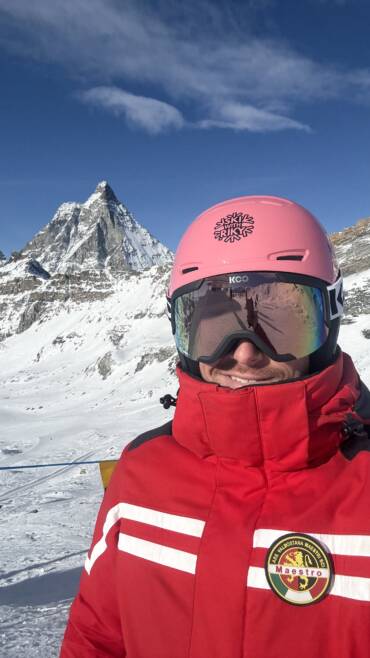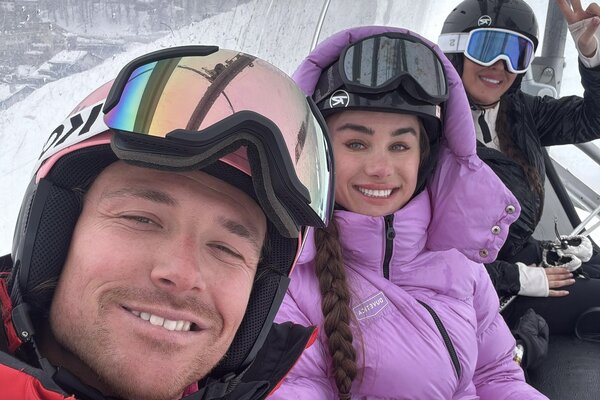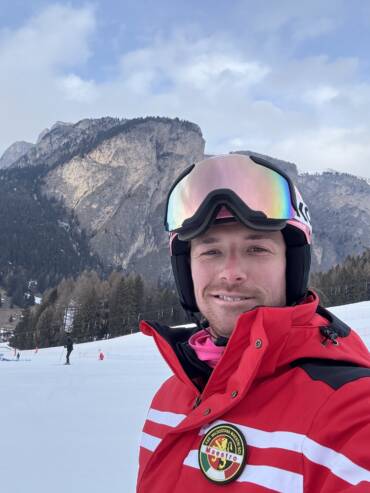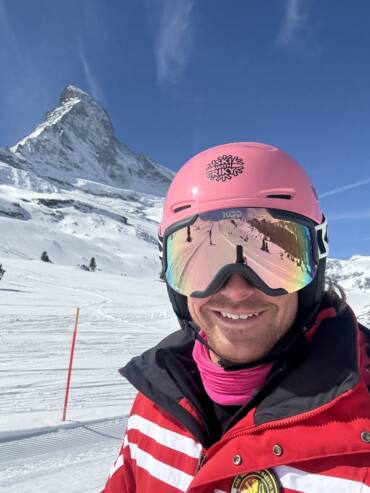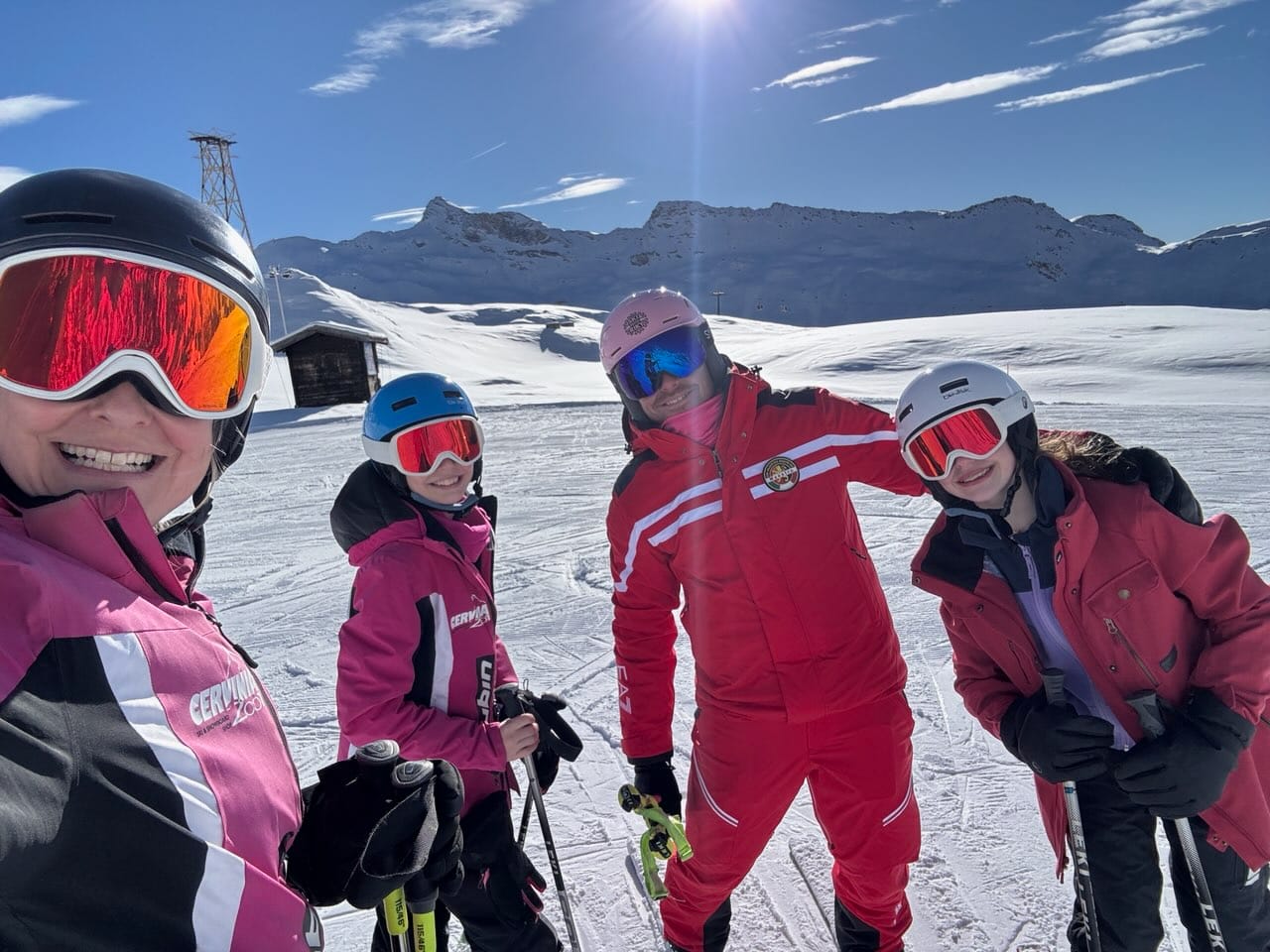
If you are looking for a private ski instructor in Cervinia, you probably have plenty of questions before booking.
Where do we meet?
Do you have to make your own way to the slopes?
What happens during a private lesson?
Is a full day better than a half day?
Do we stop for lunch?
Can you pick us up from our hotel?
Will it be a traditional ski lesson, or will we actually spend the day skiing around Cervinia?
And perhaps the most important question:
What is it actually like to spend a day skiing with Riky?
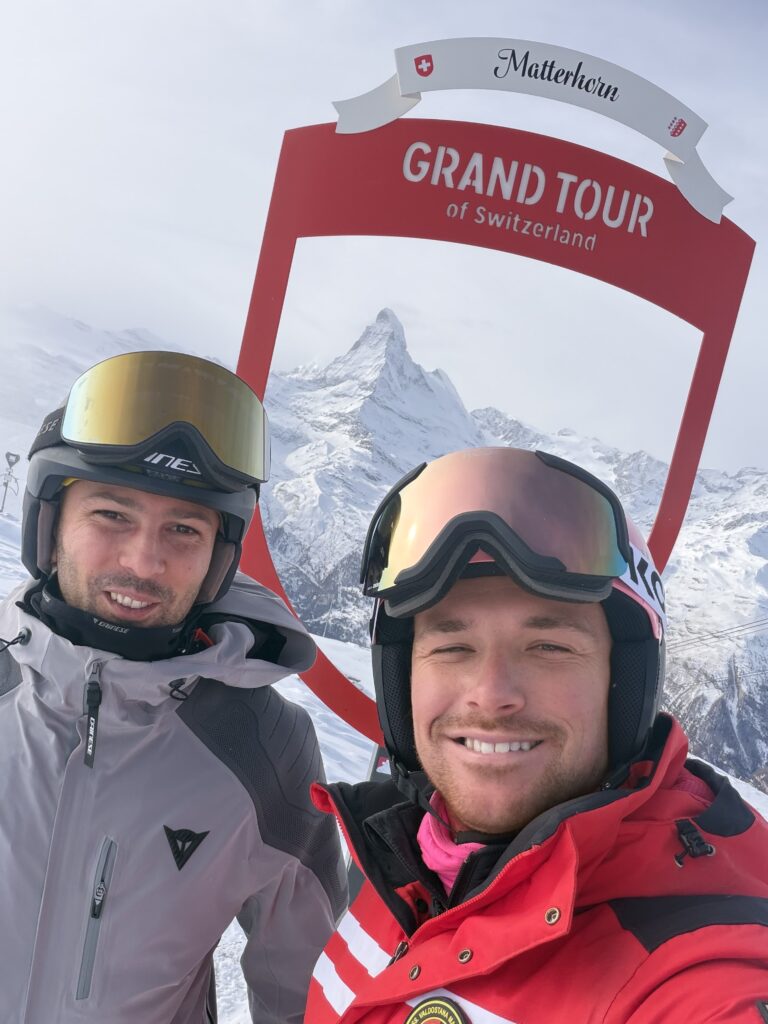
I decided to write this article because I receive many of these questions from clients before their first lesson with me.
The short answer is that my lessons are not designed to feel like a rigid two-hour class where you meet an instructor, practise a few exercises and then go home.
I am an independent private ski instructor and guide, and my goal is to make the time we spend together on the mountain productive, enjoyable and personal.
Depending on what you are looking for, you can book a morning half day from 09:00 to 13:00, an afternoon half day from 13:30 to 16:30, or, what I personally recommend whenever possible, a full day from 09:00 to 16:30.
The full-day experience is particularly special because it gives us enough time to ski, improve your technique, explore the mountain, stop for lunch together and genuinely get to know each other.
In many cases, by the end of the day, it feels less like you have spent the day with someone you have just met and more like you have been skiing with a friend.
That personal relationship is one of the things I value most about my work.
My Private Ski Lessons in Cervinia
My lessons are private, which means that I work directly with you and the people you are travelling with.
I don’t run large mixed groups where people of completely different abilities are put together.
If you book a private lesson with me, the day is built around your group, your skiing level, your goals and the conditions on the mountain.
This also means that the lesson can change during the day.
Perhaps you originally wanted to improve your carving but, after skiing together, I realise that there is another technical aspect that would make a bigger difference to your skiing.
Perhaps you are already an experienced skier and don’t need traditional exercises at all.
Perhaps your main goal is to discover Cervinia and ski some of the best terrain available.
Or perhaps you want to spend the day crossing into Switzerland and skiing in Zermatt, if conditions allow.
There isn’t one formula that works for everybody.
That is why I don’t believe in treating every client in exactly the same way.
What Time Does a Ski Lesson Start?
I offer three main options.
Morning Half Day: 09:00–13:00
The morning session lasts four hours.
This is the option I generally recommend to clients who want a substantial amount of skiing but don’t want to spend the entire day on the mountain.
Starting at 09:00 also allows us to take advantage of the morning conditions and make good use of the first part of the ski day.
A four-hour session gives us enough time to:
- warm up properly
- assess your skiing
- work on technique
- ski different terrain
- practise specific skills
- explore part of the ski area
- adapt the lesson according to conditions
It is significantly more than a short introductory lesson.
Afternoon Half Day: 13:30–16:30
The afternoon session runs from 13:30 to 16:30.
This can be a very good option for clients who prefer a later start, perhaps because they have arrived in Cervinia during the morning or want to spend the morning skiing with family or friends.
Three hours is enough time to have a productive session, particularly when we know what we want to work on.
The afternoon can also be particularly enjoyable because we can adapt the skiing to the snow and weather conditions we find during the day.
However, when clients ask me whether they should book three or four hours, I will usually recommend the four-hour morning session if their schedule allows.
Those extra hours make a difference.
Full Day Ski Lesson: 09:00–16:30
This Is the Experience I Recommend Most
If you have the time, the full-day private ski experience from 09:00 to 16:30 is my favourite way to work with clients.
And there is a simple reason.
A full day gives us time to do much more than simply teach you how to ski.
We can ski.
We can improve your technique.
We can explore the resort.
We can adapt the day to the conditions.
We can take breaks when needed.
We can have lunch together.
And we can actually enjoy the mountain without constantly looking at the clock.
That last point is important.
When you book a short lesson, every minute matters.
With a full day, the atmosphere is completely different.
We have time.
And when you have time, I can concentrate on giving you the best experience rather than trying to fit everything into a limited window.
I Pick You Up at Your Hotel
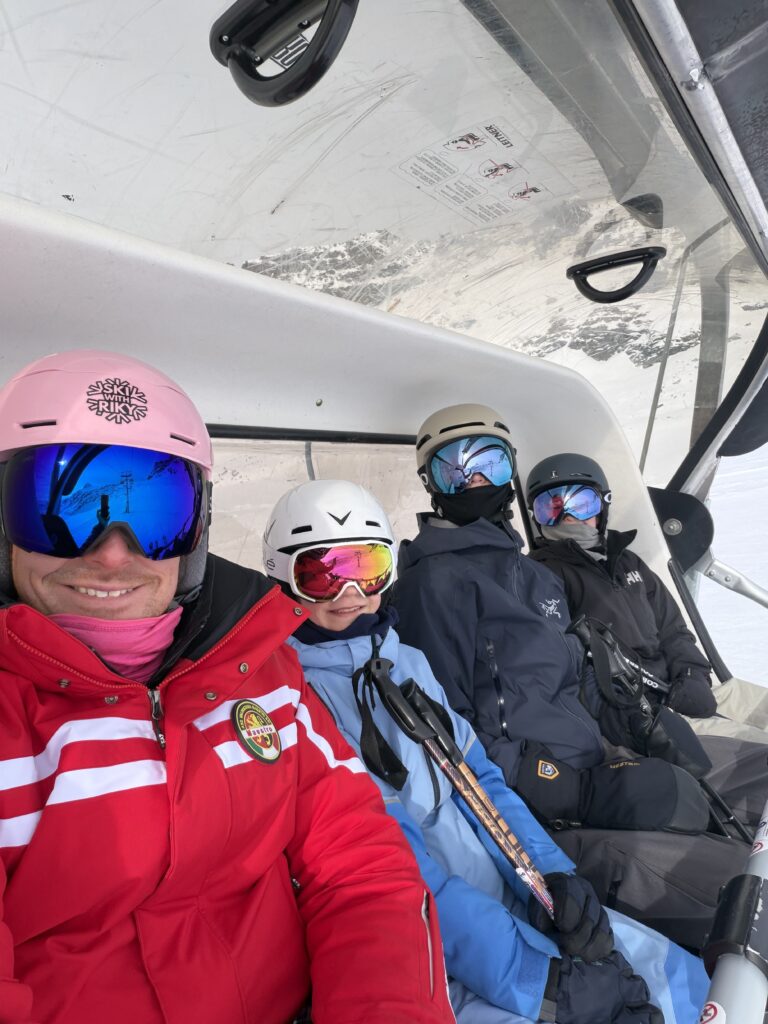
One of the things that makes my full-day experience different is that I can come and pick you up at your hotel in the morning.
Instead of asking you to find a meeting point on the mountain, organise your equipment and then somehow find your instructor, I prefer to make the beginning of the day as easy as possible.
We arrange where you are staying and the most practical meeting point.
I come to meet you at the hotel, and from there we start the day together.
For families, this can be particularly convenient.
You don’t have to organise another transfer or worry about getting everyone to a meeting point at exactly the right time.
You simply get ready, put on your ski boots and meet me.
From that moment, the day starts.
The Day Starts Before We Even Reach the Slopes
One of the advantages of meeting at the hotel is that we can already talk about the day before we start skiing.
I can ask you about:
- your skiing experience
- what you want to improve
- where you have skied before
- whether you are interested in exploring Zermatt
- whether you are skiing with children
- what kind of terrain you enjoy
- whether there are any particular concerns or goals
This initial conversation is useful because it gives me a better understanding of what you are looking for.
Some clients want technique.
Others want adventure.
Some want both.
The First Part of the Lesson: Understanding Your Skiing
Once we are on the mountain, I don’t immediately start giving you a list of technical exercises.
First, I want to see you ski.
I need to understand your current level.
How do you turn?
How do you control your speed?
How do you deal with steeper terrain?
How comfortable are you on different snow conditions?
Do you naturally carve your skis or rely more on skidding?
How relaxed are you?
How confident are you?
Sometimes a skier’s biggest problem isn’t technical at all.
They may simply lack confidence.
Other times, somebody can ski very fast but has developed habits that prevent them from progressing.
My job is to recognise those differences.
A Lesson Is Not Always About Doing Exercises
This is something I explain to clients quite often.
A private ski lesson doesn’t necessarily mean spending four hours doing repetitive drills.
Exercises are useful.
Very useful.
But they are a tool, not the entire lesson.
If you are an experienced skier, I may spend very little time on formal exercises.
Instead, I might show you a different line through a piste, explain how to manage your edges, work on your turn shape and then immediately apply that technique while skiing normally.
The objective is always to make the improvement useful when you actually ski.
After all, nobody books a ski holiday because they want to spend four days doing exercises.
They want to ski.
Skiing the resort With a Local
One of the advantages of booking a private instructor who works regularly in Cervinia is that I know the mountain well.
I can adapt the day to:
- snow conditions
- visibility
- lift queues
- piste conditions
- your ability
- your energy levels
- the weather
- what you would like to see
Cervinia has a huge variety of skiing, from wide and relatively gentle pistes that are perfect for developing confidence to steeper and more technical terrain for experienced skiers.
And when conditions are right, there is also fantastic off-piste terrain.
You can read more about the different areas in my Cervinia Ski Slopes Guide, where I explain the character of the different parts of the ski area and what different types of skiers can expect.
The day doesn’t have to follow a fixed route.
That is one of the advantages of having me with you.
What About Zermatt?
If conditions, lifts and your skiing level allow it, a full day can also become an opportunity to explore the Cervinia–Zermatt ski area without stress.
This is one of the most spectacular ski areas in the Alps, and for many international clients it is one of the main reasons they choose Cervinia.
However, I never promise a Zermatt day regardless of conditions.
Mountain weather, wind, lift operations, visibility and snow conditions always come first.
If everything lines up, crossing into Switzerland can turn an already great day into a memorable one.
If conditions aren’t suitable, there is plenty of fantastic skiing to enjoy on the Italian side.
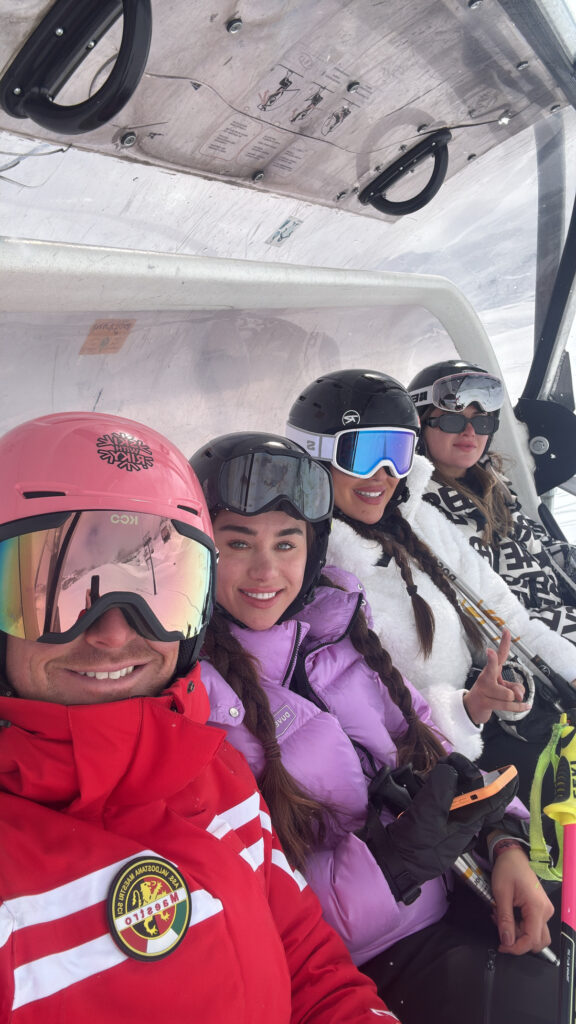
The Importance of Taking Breaks
Skiing for seven and a half hours without stopping would not make much sense.
Breaks are part of the experience.
Sometimes we stop for a coffee.
Sometimes you need five minutes to catch your breath.
With children, breaks become even more important.
A hot chocolate can sometimes be more effective than another twenty minutes of skiing!
The objective is not to maximise the number of metres skied.
The objective is to have a great day on the mountain.
Lunch Together: One of the Best Parts of the Day
And then there is lunch.
Lunch is not included in the lesson price.
The restaurant, food and drinks are your own responsibility.
However, over the years, something has happened naturally with many of my clients.
They have invited me to have lunch with them.
And I have to say that I really enjoy this part of the day.
I never expect it and it is absolutely not a requirement.
But when clients invite me to join them, I am always happy to sit down together, have something to eat and continue talking about the day.
And this is where the relationship often changes.
From Client to Friend
This might sound unusual when talking about a professional ski lesson.
But it is one of the things I like most about my job.
During the morning, we ski together.
I teach you.
You ask questions.
We laugh.
I probably make fun of you when you do something wrong!
You improve.
Then we sit down for lunch and talk about something completely different.
Where are you from?
What do you do?
Where else have you travelled?
What are you doing tomorrow?
What restaurant should you try tonight?
And suddenly, the relationship isn’t just instructor and client anymore.
Of course, I remain your professional ski instructor.
But the atmosphere becomes much more relaxed.
Many clients have told me that this personal side of the experience is one of the things they remember most.
And some of the people who first came to me as clients have returned year after year.
That means a lot to me.
Lunch Is Not Just a Break
For me, lunch is also part of the experience of skiing in Italy.
Food is an important part of the culture here.
Stopping at a mountain restaurant, sitting outside when the weather is good, looking at the Matterhorn and talking about the morning is something I think should be enjoyed rather than rushed.
If you ask me where to eat, I can also give you recommendations based on what you are looking for.
I have personally eaten in many of the restaurants around Cervinia, so I can suggest places depending on whether you want something traditional, relaxed, special or simply convenient.
I have written more about this in my guide to the Best Restaurants in Cervinia, which can be useful when planning your ski holiday.
After Lunch: The Day Continues
After lunch, we put our skis back on and continue.
This is another reason why I love the full-day format.
The afternoon often feels completely different from the morning.
By this point, I know your skiing much better.
You know how I teach.
We have already worked on the main technical points.
And we can now spend more time simply skiing.
Maybe we explore another part of Cervinia.
Maybe we ski longer runs.
Maybe we work on applying the morning’s technical improvements.
Maybe we head towards Zermatt if the conditions allow.
The afternoon becomes more fluid.
I Don’t Watch the Clock All Day
One of the advantages of booking directly with me is the personal nature of the service.
I am not trying to get through a fixed number of clients during the day.
I have one group in front of me.
You.
That means I can adapt.
If we need another run, we take another run.
If you need a break, we take a break.
If the conditions change, we change our plan.
If you are having an amazing time and want to explore another part of the mountain, we can do that when appropriate.
Obviously, the lesson has a defined start and finish time.
But within that framework, the day can breathe.
What Happens at the End of the Day?
At approximately 16:30, we finish skiing.
And the service doesn’t simply end when we take off our skis.
For full-day clients staying in Cervinia, I can take you back to your hotel at the end of the day.
So the experience is essentially:
Hotel → Mountain → Skiing → Lunch → More skiing → Hotel
You don’t have to worry about finding your way back after a full day on the slopes.
You can simply relax.
For families with children, this is particularly convenient.
After a full day skiing, everyone is usually ready for a shower, a rest and perhaps an aperitivo!
What Is Included in a Private Ski Lesson?
The exact service depends on the lesson you book, but my private ski instruction generally includes:
- private instruction with me
- personalised coaching
- technical feedback
- route planning according to your level
- local mountain knowledge
- adaptation to snow and weather conditions
- guidance around the Cervinia ski area
- the possibility of exploring different terrain
- hotel pick-up for full-day arrangements in Cervinia
- return to your hotel at the end of the full day
- a flexible, personal approach
For specific arrangements, especially outside standard Cervinia lessons, I always recommend contacting me directly.
What Is Not Included?
There are also a few things that are not included in the lesson price.
These normally include:
- ski pass
- ski equipment
- insurance
- food and drinks
- personal expenses
Lunch is therefore not included in the lesson price.
If you invite me to join you for lunch, I am very grateful, but it is completely optional and never expected.
The same applies to drinks or anything else during the day.
Do I Need to Bring My Own Equipment?
You don’t need to own ski equipment.
If you need skis, boots, poles or other equipment, I can recommend reliable rental options.
I can also help you understand what type of equipment would be appropriate for your skiing level.
This is another advantage of contacting me before your holiday rather than trying to organise everything once you arrive.
If you are planning your first trip to Cervinia, my Plan Your Ski Holiday in Cervinia guide can also help you organise the rest of your trip.
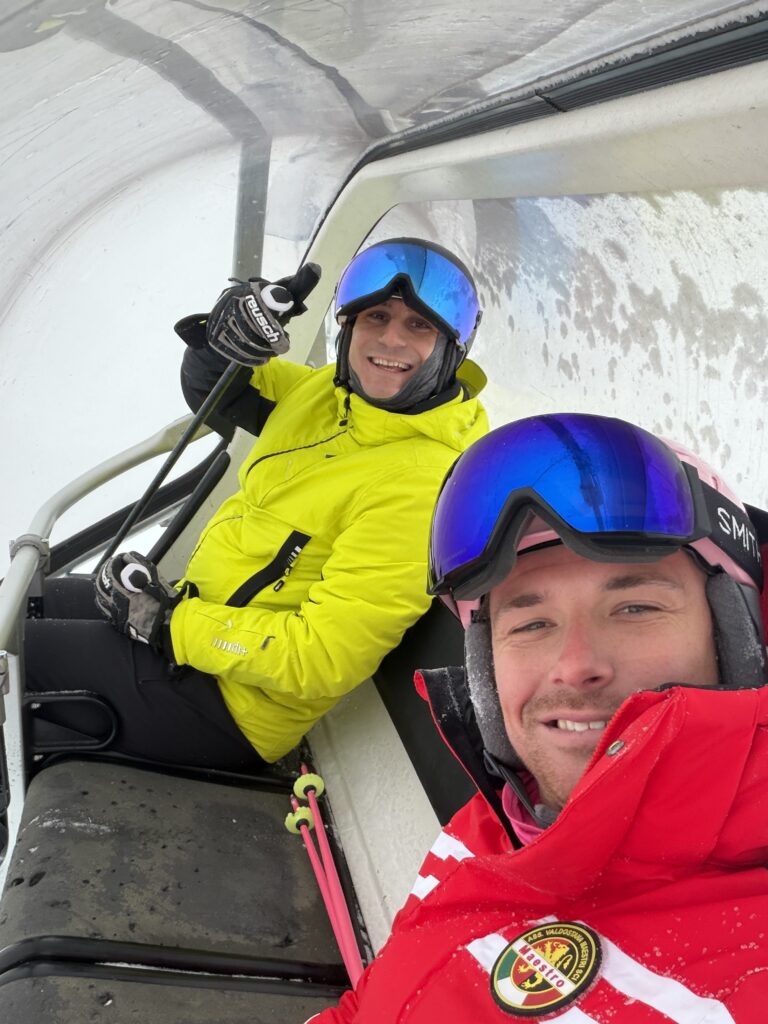
What Happens If the Weather Is Bad?
This is a very common question.
Skiing does not always happen under perfect blue skies.
Fog, snow, wind and poor visibility are all part of skiing in the Alps.
A lesson does not automatically become useless because the weather isn’t perfect.
In fact, learning how to ski in different conditions is an important part of becoming a better skier.
Of course, safety always comes first.
If lifts are closed or conditions are considered unsafe, the situation changes.
But ordinary poor visibility or snowfall does not automatically mean that a lesson cannot be productive.
Sometimes those days are actually very useful for improving technique and learning to rely less on simply seeing a perfect piste in front of you.
What If You Are Skiing With Children?
Private lessons are particularly useful for families because I can adapt the pace to the children.
Children don’t necessarily need to ski continuously for hours.
They need breaks.
They need variety.
And occasionally they need a hot chocolate!
With a full-day family booking, we can structure the day around their energy levels rather than following a rigid programme.
Parents can also have a more relaxed experience because I can take care of the skiing while they enjoy the mountain with the family.
If the children have different abilities, let me know before booking so I can understand the group and recommend the best arrangement.
Can Beginners Book a Full Day?
Yes.
A full day is not only for advanced skiers.
For a beginner, a full day can actually provide enough time to progress without constantly feeling rushed.
However, the structure will be very different.
We may spend the morning developing the basics and confidence, take appropriate breaks and then gradually build on those skills during the afternoon.
For a complete beginner, the most important thing is not to ski as much terrain as possible.
It is to create a positive foundation.
What About Advanced Skiers?
This is where the private format becomes particularly valuable.
If you are already an experienced skier, you probably don’t need someone simply telling you how to make a turn.
You may want to improve carving.
You may want to ski steeper terrain more confidently.
You may want to explore off-piste terrain.
You may want to understand how to adapt your technique to different snow.
Or perhaps you simply want someone who knows Cervinia and Zermatt extremely well and can show you where to go.
The lesson can therefore become much more like a guided technical ski day.
Off-Piste Skiing
When conditions are suitable, I can also introduce experienced skiers to off-piste terrain.
However, off-piste skiing requires a different approach to piste skiing.
Safety comes first.
Depending on the terrain and conditions, appropriate avalanche equipment is required, including:
- transceiver
- shovel
- probe
Equipment can be rented locally where necessary.
I assess conditions and the group before deciding whether off-piste skiing is appropriate.
It is never something I promise simply because a client requests it.
Why I Recommend the Full Day
If you have read this far, you have probably understood why I tend to recommend the full-day experience.
A three-hour afternoon lesson can be excellent.
A four-hour morning lesson can be excellent.
But 09:00–16:30 gives us an entirely different amount of freedom.
It allows us to combine:
Ski instruction + guiding + mountain experience + lunch + personal time together.
There is enough time to improve your skiing without making the entire day feel like a technical lesson.
There is enough time to explore.
There is enough time to stop.
There is enough time to talk.
And there is enough time for the day to become an experience rather than simply a lesson.
That is what I am trying to create with Ski With Riky.
More Than Just Skiing
This is why one of the phrases I use for my business is:
Not Just Skiing.
Because that is genuinely what I believe a private ski day can be.
You are not simply paying somebody to stand beside you and explain how to bend your knees.
You are spending a day with someone who knows the mountain, understands skiing and can adapt the experience around you.
I want you to finish the day feeling that you have:
- improved your skiing
- discovered something new
- skied great terrain
- enjoyed good food
- laughed
- relaxed
- and had a memorable day in Cervinia
And hopefully, when you come back the following year, you will want to ski together again.
Frequently Asked Questions About Ski Lessons with Riky
Where do you meet for a private ski lesson in Cervinia?
For full-day arrangements, I can come and meet you at your hotel in Cervinia and then accompany you to the mountain. The exact arrangement can be confirmed when booking.
Do you pick clients up from their hotel?
Yes. For my full-day private experience in Cervinia, hotel pick-up and return to the hotel are part of the service I aim to provide.
What are your lesson times?
My standard options are 09:00–13:00 for a morning half day, 13:30–16:30 for an afternoon half day, and 09:00–16:30 for a full day.
Which lesson duration do you recommend?
If your schedule allows it, I generally recommend the full day because it gives us enough time to combine instruction, skiing, exploring and lunch without feeling rushed.
Is lunch included?
No. Lunch and drinks are not included in the lesson price. Clients sometimes invite me to join them for lunch, which I always appreciate, but it is entirely optional.
Do you eat lunch with your clients?
When clients invite me to join them, yes. It is one of the parts of the day I particularly enjoy because it gives us time to relax and get to know each other away from the skis.
Is the ski pass included?
No. The ski pass is not included in the lesson price.
Is ski equipment included?
No. Ski equipment is not included, but I can recommend rental options and help you understand what equipment is appropriate for your level.
Can you teach beginners?
Yes. I work with skiers of different levels, from beginners to advanced skiers.
Can you teach advanced skiers?
Yes. With experienced skiers, the focus can be on technique, carving, steeper terrain, different snow conditions, mountain guiding or exploring Cervinia and Zermatt when conditions allow.
Can we ski in Zermatt?
If conditions, lift operations and your skiing level allow it, we can plan a day in the Cervinia–Zermatt area. It is always dependent on mountain conditions and lift availability.
What happens if the weather is bad?
Lessons can often still take place in poor visibility or snowfall. The plan may be adapted to the conditions. If lifts are closed or conditions are unsafe, the situation will be assessed accordingly.
Can you recommend restaurants for lunch?
Absolutely. I know many of the restaurants around Cervinia personally and can recommend places depending on what you are looking for.
Can you help organise other parts of our ski holiday?
Yes. When clients book lessons with me, I am often happy to help with practical suggestions regarding restaurants, ski rental, transfers and other aspects of their stay.
Book a Private Ski Lesson with Riky in Cervinia
If you are looking for a private ski instructor in Cervinia and want something more personal than a standard ski lesson, I would be happy to spend a day on the mountain with you.
Whether you choose a morning half day from 09:00 to 13:00, an afternoon session from 13:30 to 16:30, or the full-day experience from 09:00 to 16:30, my goal is the same:
to make your time on the mountain enjoyable, productive and memorable.
And if you have the possibility to book a full day, that is the option I would personally recommend.
I’ll come to meet you at your hotel, we’ll spend the day skiing together, stop for lunch, explore the mountain, work on your skiing and — hopefully — finish the day feeling that we have had much more than just a ski lesson.
Because for me, that’s what Not Just Skiing means.
If you’re planning your ski trip to Cervinia and would like to book a private ski lesson or full-day ski experience with me, don’t hesitate to reach out — you can email me anytime at info@skiwithriky.com. I’ll be happy to discuss your group, your skiing level, your dates and what you would like to get out of your time on the mountain.
See you on the slopes,
Riky